Been very quiet for a long time - variations between nothing to report, and oh-Lordy-so-much-going-on-it's-the-last-thing-I-can-do-to-blog-about-it.
Well, that's holidays for you.
I'm now back in the UAE, back at work, and no less busy than ever. A bit fitter and thinner (marginally) and taking steps to become more so. Back behind a screen more often, as well.
So there will be more to come.
Some of it might even be good.
Watch this space, as they used to say on telly.
Saturday, 5 September 2009
Wednesday, 3 June 2009
Meanwhile... back at the farm...
While all this has been going on, back in my home country we're having an election.
Not the kind of election most people get excited about, where you might have an outside chance of changing the government. Nor the kind of election that it seems from away over here my compatriots would rather enjoy at this stage, with greedy, self serving MPs swinging from every lamppost.
No, it will be one of those elections people don't normally bother to get out of bed for. Except tomorrow, I rather think they will.
We (or rather they, as I missed my registration) are voting for local government councillors and members of the European parliament... I'm ashamed to say I don't know who my MEP is. This sort of thing would normally attract a turnout of about 20% of the electorate, in a good year. Tomorrow I hope it will be massive. The opinion polls don't really know how to read it: bad for Labour, the party in power (a massive recession followed by a huge scandal... lovely!) but possibly also bad for the Tories (umm... what's different about them on policy?... errr....).
One curious thing over the last 20 years or so is that there has become essentially no difference in policy between the two main parties: both agree with more privatisation, even of social services like the NHS, deregulation of business and financial services (and we now know how well that has worked out) and increasing authoritarian control.
We haven't, so far as I am aware, ever had a national debate about whether we wanted these things (in fact I seem to recall all parties insisting that they were NOT trying to sell off the NHS, the London Underground, schools, the Post Office, while all the time the creeping tides of privatisation lapped ever higher around them).
But where there is no difference in belief, parties have to compete on their competence and honesty. Nobody's debating what the government should do, just whether party x or party y will manage to do it without leaving top secret information on the 7.15 train to Waterloo, and without vastly enriching its MPs at public expense.
The Labour party has failed on both counts, but the Conservatives have been equally corrupt, and show no signs of being any more efficient.
So it's an interesting election all right. I wish I was there.
Not the kind of election most people get excited about, where you might have an outside chance of changing the government. Nor the kind of election that it seems from away over here my compatriots would rather enjoy at this stage, with greedy, self serving MPs swinging from every lamppost.
No, it will be one of those elections people don't normally bother to get out of bed for. Except tomorrow, I rather think they will.
We (or rather they, as I missed my registration) are voting for local government councillors and members of the European parliament... I'm ashamed to say I don't know who my MEP is. This sort of thing would normally attract a turnout of about 20% of the electorate, in a good year. Tomorrow I hope it will be massive. The opinion polls don't really know how to read it: bad for Labour, the party in power (a massive recession followed by a huge scandal... lovely!) but possibly also bad for the Tories (umm... what's different about them on policy?... errr....).
One curious thing over the last 20 years or so is that there has become essentially no difference in policy between the two main parties: both agree with more privatisation, even of social services like the NHS, deregulation of business and financial services (and we now know how well that has worked out) and increasing authoritarian control.
We haven't, so far as I am aware, ever had a national debate about whether we wanted these things (in fact I seem to recall all parties insisting that they were NOT trying to sell off the NHS, the London Underground, schools, the Post Office, while all the time the creeping tides of privatisation lapped ever higher around them).
But where there is no difference in belief, parties have to compete on their competence and honesty. Nobody's debating what the government should do, just whether party x or party y will manage to do it without leaving top secret information on the 7.15 train to Waterloo, and without vastly enriching its MPs at public expense.
The Labour party has failed on both counts, but the Conservatives have been equally corrupt, and show no signs of being any more efficient.
So it's an interesting election all right. I wish I was there.
Playing God with the Mogs
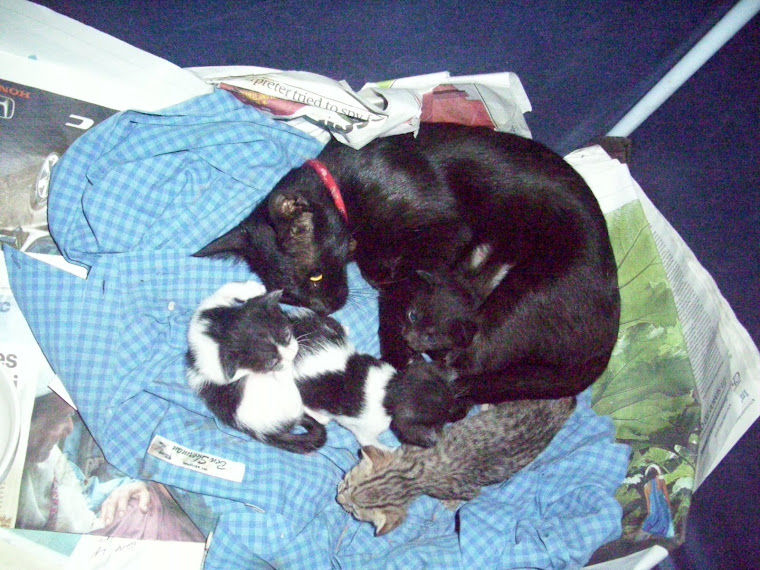
Roxy's kittens are thriving and rampaging around the house.
While still feeding them milk, Roxy celebrated the kits' near-independence by ... going on heat and rampaging around the house singing her eerie love songs. I suppose that, having made a rather good job of bringing 4 healthy moglets into the world, she thought now would be the time to start another 4, and another, and another.
We thought otherwise. She was scragged, bundled into one of the shiny new cat carriers we've got, and delivered to the vet under protest.
He's a good man, our vet. Very critter-oriented, it took 3 visits before he made eye contact with us primates. All the same, we felt like murderers.
She was at the vets for 3 days, during which the kittens wandered about looking anxious and deprived. We did much the same.
Yesterday we brought the poor mog back, complaining loudly. Her flank has been shaved and painted blue, with a neat row of staples pinning her wound together. I sat in the back with the cat carrier open and stoked her head all the way home. At first she was just cowering and moaning (especially on the roundabouts - not surprising given some of the driving we could see), but as we got into our neighbourhood she stretched her neck up to peer through the windows, and I would not be surprised if she recognised perfectly well where we were.
Once indoors she was immediately surrounded by the kittens, who sniffed her, kissed her whiskers, stroked their tails along her flanks, and licked her ears. She licked them back. It was so clearly an affectionate reunion that we felt, if anything, even more guilty for taking her away. The next thing was that she lay down and fed them... at least, they all sucked away frantically and, apparently, we satisfied.
She is obviously aching and rather cranky - tends to crouch and moan, and walks stiffly. This will pass. But she has also lost some of her trust in us, and is not happy having us pick her up. She cowers when we come close, which is upsetting. It seems that she is afraid we will grab her, stick her in a cage, and whisk her away to a strange place where people do painful things to her.
The worst of it is that we will, on Sunday, when we take her back to have the staples taken out.
Poor Roxy.
She'll get over it, but I'm not sure whether we will.
While still feeding them milk, Roxy celebrated the kits' near-independence by ... going on heat and rampaging around the house singing her eerie love songs. I suppose that, having made a rather good job of bringing 4 healthy moglets into the world, she thought now would be the time to start another 4, and another, and another.
We thought otherwise. She was scragged, bundled into one of the shiny new cat carriers we've got, and delivered to the vet under protest.
He's a good man, our vet. Very critter-oriented, it took 3 visits before he made eye contact with us primates. All the same, we felt like murderers.
She was at the vets for 3 days, during which the kittens wandered about looking anxious and deprived. We did much the same.
Yesterday we brought the poor mog back, complaining loudly. Her flank has been shaved and painted blue, with a neat row of staples pinning her wound together. I sat in the back with the cat carrier open and stoked her head all the way home. At first she was just cowering and moaning (especially on the roundabouts - not surprising given some of the driving we could see), but as we got into our neighbourhood she stretched her neck up to peer through the windows, and I would not be surprised if she recognised perfectly well where we were.
Once indoors she was immediately surrounded by the kittens, who sniffed her, kissed her whiskers, stroked their tails along her flanks, and licked her ears. She licked them back. It was so clearly an affectionate reunion that we felt, if anything, even more guilty for taking her away. The next thing was that she lay down and fed them... at least, they all sucked away frantically and, apparently, we satisfied.
She is obviously aching and rather cranky - tends to crouch and moan, and walks stiffly. This will pass. But she has also lost some of her trust in us, and is not happy having us pick her up. She cowers when we come close, which is upsetting. It seems that she is afraid we will grab her, stick her in a cage, and whisk her away to a strange place where people do painful things to her.
The worst of it is that we will, on Sunday, when we take her back to have the staples taken out.
Poor Roxy.
She'll get over it, but I'm not sure whether we will.
Monday, 1 June 2009
so much to blog, so little time
The pace just gets quicker, with teaching and grading, testing and final presentations all galloping faster and faster to the end of the week. Something in my brain goes dead and I find myself sneaking peeks onto the net...
And answering emails. There has been an email-based debate about teaching vocab here - basically, what when and how.
The background to it is that on the course I teach, a new target is for students to "learn" - which means they must be assessed - on the Academic Word Lists, the top frequency words in Academic writing.
This came in for the first time 2 years ago. So one of my big jobs last year was devising assessments... which we now have a bunch of.
Oddly, the requirement for the course was that students should demonstrate passive understanding of 65% of the list and active production of 60% of the list... I suspect the figures should be rather different for realistic language learning (I'd guess 75% passive recognition - 50% active production would be more likely, though I don't know any research on the figures).
Anyway, devising an instrument that assesses production is quite hard, and the freer the production the harder it is.
There is now the suggestion that some of the AWL should be devolved down onto the level below.
However, the problem I notice most is not with students learning an academic word list (they are good at "learning" - in the sense of "memorising the translation of" lists of words). It is with the more basic vocabulary - what is often called the basic 3,000 words.
Plus they suffer difficulties with forming sentences and word forms (as in history - historical - historian) - it seems hard for students to recognise what a plausible sentence of English looks like, even into their 2nd year. Obviously, this affects their writing, but it also affects their reading.
A lot of exam reading comprehension consists of recognising parallel expressions (so in a text which mentions "eyesight" the question might ask about "vision") - one expression might contain the Academic list word but the other will use a paraphrase.
Students sometimes say "I know what this means in Arabic" but being unable to find other English words is a barrier (and it also encourages students to plagiarise... another can of worms).
Personally, I think that more lists would be pretty deadly - another move, as if we needed more, towards the "memorise-test-forget" cycle a lot of our teaching seems to aim to emulate. I would like more reading - more extensive reading and more focused reading with vocab support. But it's harder to measure the benefits of that.
I even proposed a test - some students in Foundations doing the AWL earlier, and some doing extensive reading with vocab support - then see who does better in the AWL in Year 1, and in everything else.
I'd be willing to bet money the readers would not only learn the AWL's better, but score better in reading and writing....
And answering emails. There has been an email-based debate about teaching vocab here - basically, what when and how.
The background to it is that on the course I teach, a new target is for students to "learn" - which means they must be assessed - on the Academic Word Lists, the top frequency words in Academic writing.
This came in for the first time 2 years ago. So one of my big jobs last year was devising assessments... which we now have a bunch of.
Oddly, the requirement for the course was that students should demonstrate passive understanding of 65% of the list and active production of 60% of the list... I suspect the figures should be rather different for realistic language learning (I'd guess 75% passive recognition - 50% active production would be more likely, though I don't know any research on the figures).
Anyway, devising an instrument that assesses production is quite hard, and the freer the production the harder it is.
There is now the suggestion that some of the AWL should be devolved down onto the level below.
However, the problem I notice most is not with students learning an academic word list (they are good at "learning" - in the sense of "memorising the translation of" lists of words). It is with the more basic vocabulary - what is often called the basic 3,000 words.
Plus they suffer difficulties with forming sentences and word forms (as in history - historical - historian) - it seems hard for students to recognise what a plausible sentence of English looks like, even into their 2nd year. Obviously, this affects their writing, but it also affects their reading.
A lot of exam reading comprehension consists of recognising parallel expressions (so in a text which mentions "eyesight" the question might ask about "vision") - one expression might contain the Academic list word but the other will use a paraphrase.
Students sometimes say "I know what this means in Arabic" but being unable to find other English words is a barrier (and it also encourages students to plagiarise... another can of worms).
Personally, I think that more lists would be pretty deadly - another move, as if we needed more, towards the "memorise-test-forget" cycle a lot of our teaching seems to aim to emulate. I would like more reading - more extensive reading and more focused reading with vocab support. But it's harder to measure the benefits of that.
I even proposed a test - some students in Foundations doing the AWL earlier, and some doing extensive reading with vocab support - then see who does better in the AWL in Year 1, and in everything else.
I'd be willing to bet money the readers would not only learn the AWL's better, but score better in reading and writing....
Labels:
assessment,
AWLs,
career,
communication,
english,
learning,
professional,
teaching,
vocabulary
Thursday, 23 April 2009
Comfort
Due to circumstances beyond my control, I got no sleep on Monday night.
A little after 5am on Tuesday, I finally began to relax and to doze a little - the sort of semi-sleep when you can't tell your thoughts from your dreams.
Naturally, this is about the time when normal people are starting to stir - normal people, and normal small furry mammals.
We have 6 of those in the house at the moment, and the 4 little kittens are just beginning to scamper about. To scamper and to climb, as I discovered.
I dreamt, and then realised that it was truly happening, that one of the little kittens was resting its head on my arm... and she was. She had gone to sleep under my hand, having climbed all the way up to my pillow - about the equivalent of me climbing up my house to go to sleep on the roof. And she's only 4 weeks old.
I was glad it was the one we call Big Spot (or probably Molly, short for Mollipop) who we are hoping to keep. She seems to be intrepid and affectionate.
Anyway, it was a nice scrap of animal comfort after a very bad night.
A little after 5am on Tuesday, I finally began to relax and to doze a little - the sort of semi-sleep when you can't tell your thoughts from your dreams.
Naturally, this is about the time when normal people are starting to stir - normal people, and normal small furry mammals.
We have 6 of those in the house at the moment, and the 4 little kittens are just beginning to scamper about. To scamper and to climb, as I discovered.
I dreamt, and then realised that it was truly happening, that one of the little kittens was resting its head on my arm... and she was. She had gone to sleep under my hand, having climbed all the way up to my pillow - about the equivalent of me climbing up my house to go to sleep on the roof. And she's only 4 weeks old.
I was glad it was the one we call Big Spot (or probably Molly, short for Mollipop) who we are hoping to keep. She seems to be intrepid and affectionate.
Anyway, it was a nice scrap of animal comfort after a very bad night.
Monday, 20 April 2009
Turn-up for the books
"No Miss. I don't deserve it."
I've never had a student argue for a lower mark before, but it happened today.
The student's reason was not having done as well as expected (as expected by both of us, frankly) in this assessment.
I thought the mark I gave was fair (well, naturally I would think that) and, true, it would have been good for some students but was rather disappointing for this one, who is normally excellent.
It's an odd reaction, but it reminds me of going into my university exam in Anglo Saxon thinking that I hadn't prepared hard enough and really deserved to fail (actually I did OK - not great, but OK). But part of me felt I deserved to do much much worse.
Seems to me there are two issues here. One is the basic feeling that performance and result, or effort and result, should match up, which most teachers (and students) would agree is a Good Thing generally.
Now, while performance should match result (in a sense the performance is the result) it isn't necessarily true that effort matches result. I have known students who speak virtually like native speaking teenagers but made no attempt to learn anything more since leaving their English-medium high schools, and I have known many students who valiantly struggled to improve from a very low base, and who made it to a high level of achievement.
The other issue is what the criteria for success or failure are.
When I went in to translate some bits of Anglo Saxon poetry my personal criteria was to produce a good English poem which would catch the meaning and some of the spirit of the original. Fat chance: I was nowhere within a million miles of that sort of ability or knowledge - but what I had managed was clearly good enough for the examiners to give me a creditable pass. (I still feel that wasn't good enough, but it may now be too late to go back and try to out-Seamus Heaney Seamus Heaney).
My student's criteria for success seems to be, to be able to express her ideas clearly, 100% accurately and (very important to her, this) in a totally original and amusing way.
This, needless to say, is way beyond the exam criteria.
But it is absolutely lovely to have a student who has that kind of approach.
This is the student who called me over during a reading exam and pointed to a sentence in the text. My heart sank, as I was sure she was going to ask me for help - which of course I would have to refuse. Instead she said "Miss, I LIKE this sentence." Two days later she could still recite it by heart.
I've never had a student argue for a lower mark before, but it happened today.
The student's reason was not having done as well as expected (as expected by both of us, frankly) in this assessment.
I thought the mark I gave was fair (well, naturally I would think that) and, true, it would have been good for some students but was rather disappointing for this one, who is normally excellent.
It's an odd reaction, but it reminds me of going into my university exam in Anglo Saxon thinking that I hadn't prepared hard enough and really deserved to fail (actually I did OK - not great, but OK). But part of me felt I deserved to do much much worse.
Seems to me there are two issues here. One is the basic feeling that performance and result, or effort and result, should match up, which most teachers (and students) would agree is a Good Thing generally.
Now, while performance should match result (in a sense the performance is the result) it isn't necessarily true that effort matches result. I have known students who speak virtually like native speaking teenagers but made no attempt to learn anything more since leaving their English-medium high schools, and I have known many students who valiantly struggled to improve from a very low base, and who made it to a high level of achievement.
The other issue is what the criteria for success or failure are.
When I went in to translate some bits of Anglo Saxon poetry my personal criteria was to produce a good English poem which would catch the meaning and some of the spirit of the original. Fat chance: I was nowhere within a million miles of that sort of ability or knowledge - but what I had managed was clearly good enough for the examiners to give me a creditable pass. (I still feel that wasn't good enough, but it may now be too late to go back and try to out-Seamus Heaney Seamus Heaney).
My student's criteria for success seems to be, to be able to express her ideas clearly, 100% accurately and (very important to her, this) in a totally original and amusing way.
This, needless to say, is way beyond the exam criteria.
But it is absolutely lovely to have a student who has that kind of approach.
This is the student who called me over during a reading exam and pointed to a sentence in the text. My heart sank, as I was sure she was going to ask me for help - which of course I would have to refuse. Instead she said "Miss, I LIKE this sentence." Two days later she could still recite it by heart.
Labels:
assessment,
english,
grades,
learning,
surprise,
teaching,
what's it all about
Thursday, 16 April 2009
Conference workshop
For a while now I've been posting mainly about moggies, which may have given the impression that I do nothing but play with the kitties (while waiting for my manicured nails to dry and in between making the maid's life a misery). But no, I do a bit of work for my keep from time to time (only when I have to, y'understand), don't have a maid, and must have the least manicured nails in the country, if not the region.
So ... one of the things that has been happening here has been a conference on Cultivating Real Writers. Due to my neurotic urge to volunteer for things that seem interesting without considering whether they are feasible, or indeed wise, I stuck my neck out to run a writing workshop for student participants. A lot of the workshops and presentations were very pragmatic - aimed at finding out how you could improve your IELTS score in writing, for instance - so naturally I wanted to be the light relief.
The workshop uses an idea I saw someone demonstrate about 5 years ago at a NILE (Norwich Institute for Language Education) event, done by a very good chap whose name, I'm embarrassed to say, I have totally forgotten. He was a writer and teacher, and it went down very well, so I borrowed the idea - ie stole it. I'm sorry not to remember his name - I would credit him if I did - but at the time I was too interested in what was going on to make a note of it.
Anyway, the basic idea is that, if you can get someone to write a single line, then you can get them to write another single line, and then another. I use similes (as the original geezer I saw did) and try to take it through the different senses of sight, sound, taste, smell and touch, in roughtly that order.
The great thing is that neither I nor the students know what to expect, but usually (I've done this a few times in a few different contexts) what comes out is terrific.
I did the workshop twice, first with a group of lads from one of the big cities, then with a group of girls from a smaller place. Neither group had the choice of what to attend, which was rather worrying to me - they had been signed up for the workshop willy nilly.
Some of the images that came out were fantastic.
How about: "...darkness that burns until I look for a hand of light to pull me out of it"?
"Sorrow is grey like an old TV program"?
"Shyness is like a little flower in a huge heaven./When I feel shy I want to hide/so nobody will pick me."
I mean, wow! Images I would never have thought of in a million years.
They were not brilliant English speakers BTW, though some of them were pretty good, but the point is that they were using all and any of their language resources to write something fairly simple, but full of meaning.
If I have a point of view on the native speaker/non native speaker thing it is that a language belongs to anyone who uses it, perhaps especially for those who use it well, and to do that you need to play.
Also, most people told to write a poem would feel pretty shy, but writing one line - that's different. The poem is the result of the process, not the start of it.
So ... one of the things that has been happening here has been a conference on Cultivating Real Writers. Due to my neurotic urge to volunteer for things that seem interesting without considering whether they are feasible, or indeed wise, I stuck my neck out to run a writing workshop for student participants. A lot of the workshops and presentations were very pragmatic - aimed at finding out how you could improve your IELTS score in writing, for instance - so naturally I wanted to be the light relief.
The workshop uses an idea I saw someone demonstrate about 5 years ago at a NILE (Norwich Institute for Language Education) event, done by a very good chap whose name, I'm embarrassed to say, I have totally forgotten. He was a writer and teacher, and it went down very well, so I borrowed the idea - ie stole it. I'm sorry not to remember his name - I would credit him if I did - but at the time I was too interested in what was going on to make a note of it.
Anyway, the basic idea is that, if you can get someone to write a single line, then you can get them to write another single line, and then another. I use similes (as the original geezer I saw did) and try to take it through the different senses of sight, sound, taste, smell and touch, in roughtly that order.
The great thing is that neither I nor the students know what to expect, but usually (I've done this a few times in a few different contexts) what comes out is terrific.
I did the workshop twice, first with a group of lads from one of the big cities, then with a group of girls from a smaller place. Neither group had the choice of what to attend, which was rather worrying to me - they had been signed up for the workshop willy nilly.
Some of the images that came out were fantastic.
How about: "...darkness that burns until I look for a hand of light to pull me out of it"?
"Sorrow is grey like an old TV program"?
"Shyness is like a little flower in a huge heaven./When I feel shy I want to hide/so nobody will pick me."
I mean, wow! Images I would never have thought of in a million years.
They were not brilliant English speakers BTW, though some of them were pretty good, but the point is that they were using all and any of their language resources to write something fairly simple, but full of meaning.
If I have a point of view on the native speaker/non native speaker thing it is that a language belongs to anyone who uses it, perhaps especially for those who use it well, and to do that you need to play.
Also, most people told to write a poem would feel pretty shy, but writing one line - that's different. The poem is the result of the process, not the start of it.
Labels:
communication,
english,
learning,
surprise,
teaching,
what's it all about
Subscribe to:
Posts (Atom)